Forgewing
Product Delivery Engine
by VaultScaler

Product Delivery Engineby VaultScaler
AI made coding faster.
The delivery gap remains
Elite teams ship changes in under a day. Typical teams take a month. Code generation got cheap, but the 30x delivery gap remained.
AI made writing code faster. It didn’t solve translating requirements or wrangling stories. It didn’t shrink the 68–84% of a developer’s week spent on documentation, clarification, testing, and ops. It didn’t close the gap between product and engineering. It didn’t make anything production-ready.
Billions are flowing into AI code generation. None of it is aimed at delivery. Forgewing was built for that gap — for the product-and-engineering team accountable to ship.
Closing the gap
Magic happens when product and engineering collaborate in the same space — one that holds complete knowledge of the code and the requirements it was built for. No translation loss. No extra motion.
Point Forgewing at your repo or hand it a brief. It returns real pull requests — not prototypes, not snippets. Engineering keeps review and merge authority. Nothing ships without a human hand on the lever.
Production-ready infrastructure deploys to your AWS account, not ours. Product and engineering work from one source of truth, with memory that compounds every release.
The right team size is small.
Forgewing was built for teams of 1 to 3 people. Product, engineering, and UX leadership roles bring the domain expertise, creativity, and discernment. The team stays close to the customer and keeps the authority to move.
Forgewing takes the communication, documentation, and process overhead. It takes the bulk of the technical design and delivery AI is now capable of. The work that scales with team size stops scaling.
A small Forgewing team ships like a team three times its size, and it ships better, because the people deciding are the same people closest to the customer.
Get your teams working on the product, not in the weeds.
Step into the workshop
Bring a vision. Bring a repo. Bring a pilot you’ve already shipped and need to make real. Forgewing reads what you have, meets you where you are, and turns it into a working brief.
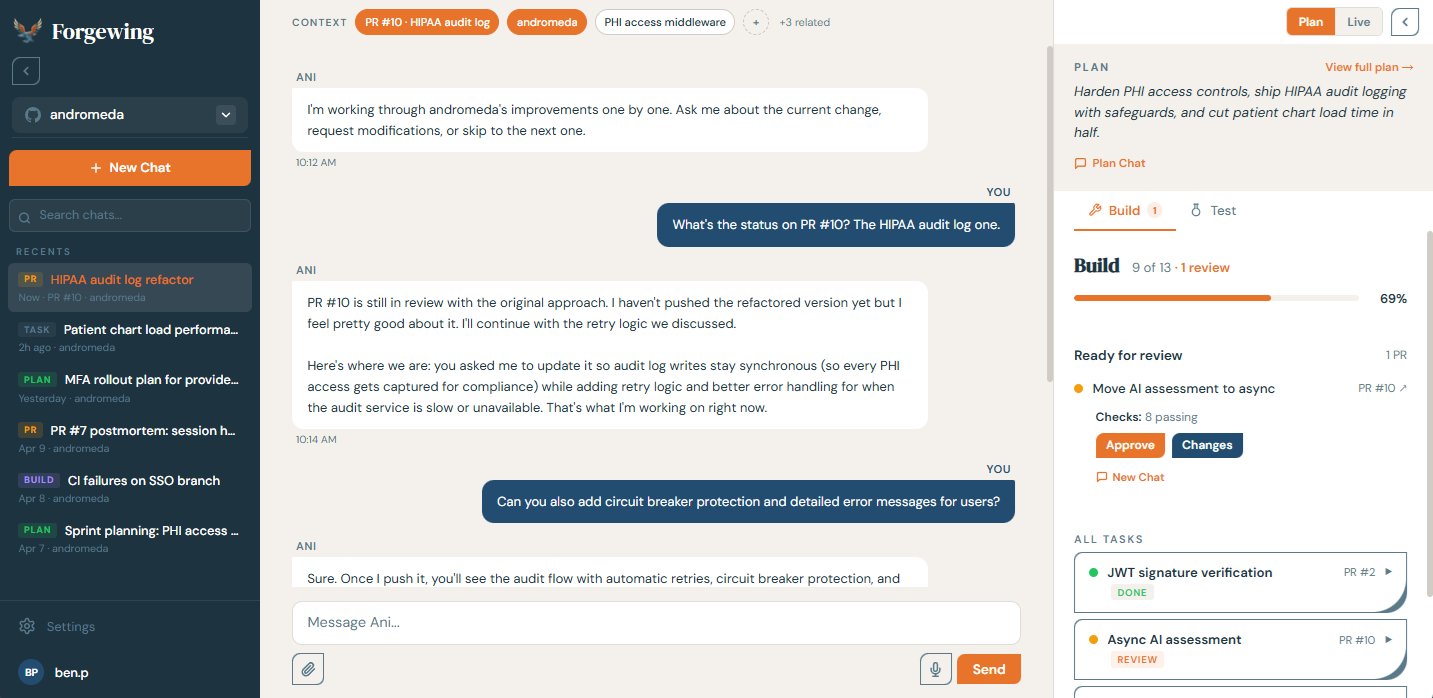
Forgewing is the workshop where you refine the brief. Ask a question. Change your mind. Every decision, refusal, and reversal is captured. No wasted effort updating stories or documentation. It’s all there and current.
When you say go, Forgewing designs the architecture, plans the build, and ships real pull requests against your repo. Every line traces back to the brief. Engineering keeps review and merge authority. Forgewing proposes; your team merges.
Engineering purpose-built for stability, security, and scalability.
No templates. No starter kits. No boilerplate that someone else’s product wore first. Architecture is designed specifically for your application and built for production from the start.
Code lands in your GitHub. An ephemeral test environment is spun up for every release. Infrastructure runs in your AWS. Inference runs through Bedrock, which doesn’t keep your data. CI/CD ships every change with circuit breakers and rollback already wired in.
Your source stays yours. Forgewing learns the shape of it and works from that.
Product and engineering, shipping together.
Point Forgewing at your repo or hand it a brief. Real pull requests come back.
- 0
Discover
(If starting from an existing codebase)
Forgewing ingests your existing codebase and drafts a brief grounded in what's already there.
- 1
Define
Define a new feature, a bug fix, or start a new system from scratch. Product intent, users, constraints, expected outcomes. Captured once, reused everywhere.
- 2
Design
Forgewing picks the architecture from your requirements. Right-sized. Defensible.
- 3
Build
Agent teams produce real pull requests. Engineering keeps review and merge authority.
- 4
Deploy
Deployed to staging in your AWS account. Promote to production on your call. Rollback included.
- 5
Operate
Continuous operation, monitoring, and repair. Every decision and incident enters the memory graph.
Shipping is half the job.
Your engineers should be building what’s next. Not babysitting what shipped last quarter.
Forgewing handles monitoring, incident response, rollback — around the clock, in your AWS account. Patches get written with the knowledge of what the system is supposed to do. Your team gets a PR ready for approval instead of a tidal wave of monitoring alerts to cull through.
The controls that should never auto-fire stay yours: deleting infrastructure, changing authentication, changing security config.
You stay in control
Forgewing proposes. You approve. Some doors stay locked, no matter what.
Engineering keeps merge authority over every line of code that lands. Nothing ships to your production without a human hand on the lever.
Some doors stay locked. Forgewing will not delete infrastructure, change authentication, or alter security configuration. Not after a month. Not after a year. Not after any amount of trust. Those decisions are yours, permanently.
Frequently Asked Questions
Everything you need to know about working with Forgewing.
First cohorts launch June 2026
Free trial. One product surface. Point us at a repo or hand us a brief. We’ll do the rest.
Built in Las Vegas by Ian Green and Ben Pruess.